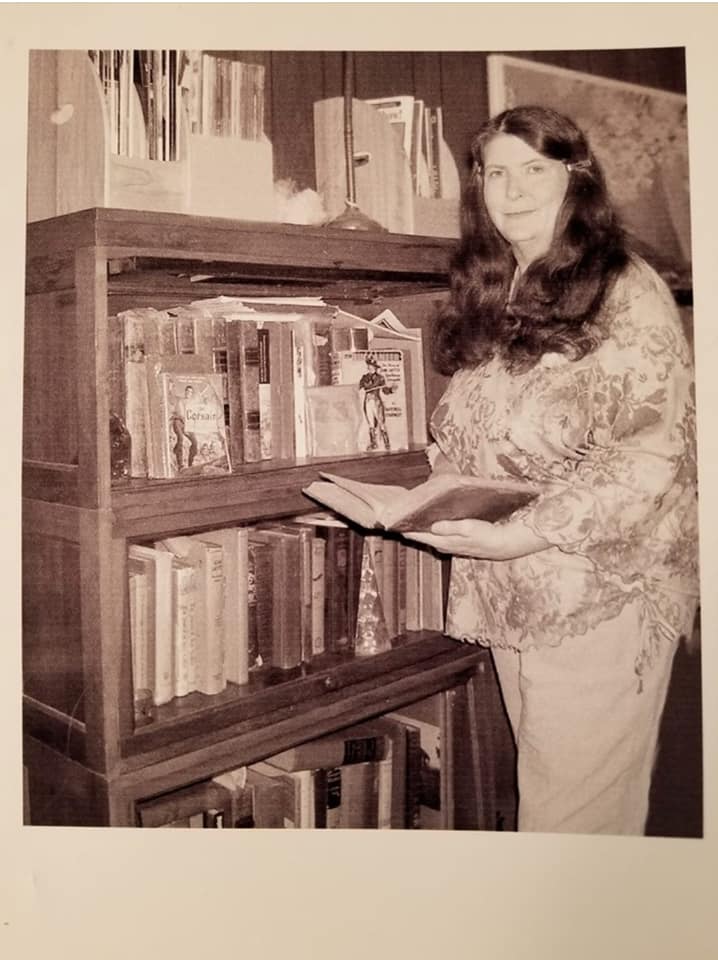

When I was writing my novel Theodosia and the Pirates, I was reading The Journal of Jean Laffite and trying to reconcile it with an 1823 obituary claiming he had died in a sea battle off the Honduran coast. The obituary troubled me. If the Journal was authentic — and I believed it was — then the man who wrote it had still been alive in the 1840s. Something didn’t add up.
I wanted to see the original Spanish language obituary for myself. William C. Davis, who had written The Pirates Laffite and cited the obituary in a footnote, seemed like the obvious person to contact. I assumed he had a copy. So I wrote to him.
Davis didn’t have it. But he forwarded my inquiry to someone who did.
Out of the ether came an email from Pam Keyes, Research Coordinator of the Laffite Society, attaching the copy of the obituary she had tracked down herself. She had never met me. I had told her nothing about my thinking or my doubts. But at the end of her email, almost as an aside, she added:
Don’t worry. He didn’t die then.
I was struck by that. She had intuited exactly what had been preoccupying me — that Jean Laffite could not have died in 1823, that the obituary was too convenient, too neat, the perfect cover for a man who needed to disappear. She knew it without my having said a word.
That was Pam Keyes. She didn’t just know the documents. She knew Jean Laffite.
A Life Devoted to a Mystery

Pam’s connection to Jean Laffite began when she was nine years old, at a drive-in movie theater in 1964, watching Yul Brynner play the famous privateer in the 1958 film The Buccaneer. Something about the story seized her imagination and never let go. She tracked down books, placed classified ads in newspapers, wrote letters to researchers across the country — all before the internet existed — building a network of Laffite scholars one handwritten letter at a time.
By the time I encountered her, decades later, she was the Research Coordinator of the Laffite Society and one of the few people in the world who had examined the Journal of Jean Laffite in person, at the Sam Houston Regional Library and Research Center in Liberty, Texas, where it is held to this day.
The Question of the Journal
The Journal of Jean Laffite is one of American history’s most contested documents. Ostensibly written by the privateer himself, it surfaced in the twentieth century through a man named John A. Laflin — also known as John Andrechyne Laflin and John Nafsiger — who presented it as the original, unaltered journal of the famous privateer. Skeptics immediately cried forgery. Laflin was a known con man, and his abused wife had privately told a friend that he had made it all up, studying how to age paper and ink.
But Pam was not so easily persuaded. She went to Liberty, Texas, and she looked at the Journal herself, bringing with her exact-size color photographs of the Le Brave ship’s articles — a document from 1819 bearing a signature universally accepted as Jean Laffite’s authentic hand. She compared them side by side.
The handwriting matched.
Not approximately. Not suggestively. The Journal’s handwriting and signature were consistent throughout, with no hesitation, no crossing out, no irregularities — and they matched the authentic 1819 Le Brave document. Her conclusion, stated carefully and honestly as a layman’s opinion rather than a forensic expert’s, was that the Journal was authentic and not a forgery.
Linguist Gene Marshall, who studied and translated the Journal, supported her view. The language — a Creole French patois with Spanish and English elements, common to the Cuba-Haiti islands — was consistent with a style of writing common before 1850. A modern forger would have had to be an extraordinarily skilled linguist to fabricate it convincingly.
As Pam noted, the final chapter on the Journal’s authenticity has never been written. It has never been conclusively proven a forgery. It has never been conclusively proven authentic. It remains, in her words, “in a gray, enigmatic haze.” Modern forensic technology could resolve the question — but no one has chosen to use it. Some mysteries, it seems, are preferred unsolved.
What the Journal Reveals
For those willing to take the Journal seriously as a historical source, it is a remarkable document. It reveals a Jean Laffite far more complex than the swashbuckling privateer of popular legend — a man shaped by profound personal history, including the suffering of his grandmother, a Spanish Jew persecuted by the Inquisition. This heritage, and the determination it forged in him, runs through the Journal as a quiet but insistent thread.
It also reveals a man who wanted desperately to be seen as honorable. As Pam explained in our interview, Laffite’s decision to help Andrew Jackson defend New Orleans was not simply patriotism or opportunism. It was the act of a man who cared deeply about his reputation — who wanted acceptance, respect, and the acknowledgment that there was a difference between a privateer and a pirate. He never accepted the presidential pardon extended to him after the Battle of New Orleans. He didn’t feel he needed one. He had done nothing wrong.
And the obituary? Pam was right. He didn’t die in 1823. The Journal, written in the 1840s in the same hand as the 1819 Le Brave document, is the most compelling evidence that Jean Laffite survived, assumed a new identity, and went on living — watching from a distance as the world debated whether he was dead or alive.
A Personal Legacy

Pam Keyes was generous with her knowledge in a way that is increasingly rare. She shared what she had found not to protect her own scholarly territory, but because she believed the truth about Jean Laffite mattered and deserved to be known. When she emailed me that copy of the obituary — a stranger who had written to the wrong historian — she asked for nothing in return. She simply added that reassurance, that quiet certainty: Don’t worry. He didn’t die then.
I never forgot it. It shaped the novel I was writing. Jean Laffite’s Jewish heritage, his grandmother’s persecution by the Inquisition, his desperate need to be seen as honorable, his survival beyond the convenient obituary — all of it is woven into Theodosia and the Pirates, a novel that could not have been written without Pam Keyes and the trail she blazed through decades of primary source research.
She is gone now. But Jean Laffite’s story — the real one, the complicated one, the one she devoted her life to uncovering — is still being told.
___________________________________________________
To read Pam Keyes in her own words, see the full interview she gave to Historia Obscura: An Interview with Pam Keyes about Jean Laffite
Theodosia and the Pirates is available on Amazon.
Comments
One response to “Remembering Pam Keyes: the woman who knew Jean Laffite”
Grateful to Pam for her enduring research, and yourself for continuing the work! #PyrateApproved